ACL Injury Prevention Exercises for Athletes: Expert Tips
ACL Prevention Tips for Athletes
ACL injuries often occur when athletes suddenly stop, change direction, or land awkwardly after jumping. These injuries can affect knee stability and interrupt sports participation for months. Research shows that structured ACL injury prevention exercises can help reduce injury risk by improving strength, balance, and movement control. Whether you play football, badminton, basketball, cricket, or kabaddi, the right training routine can help protect your knees. Here are practical exercises, landing techniques, and sport-specific tips to include in your training.
How Do ACL Injuries Happen During Sports?
The anterior cruciate ligament (ACL) connects your thighbone to your shinbone and helps stabilise your knee.
Many ACL injuries happen without direct contact with another player.
Common injury situations include:
- Sudden stops while running at high speed.
- Sharp turns with the foot planted on the ground.
- Landing from a jump with poor knee control.
- Losing balance during rapid direction changes.
- Twisting the knee during a tackle or sporting movement.
Weak muscles, poor movement control, and inadequate conditioning may increase injury risk.
Research supports combining strength, balance, and landing drills rather than relying on a single exercise.
Five Strengthening and Balance Exercises for ACL Prevention
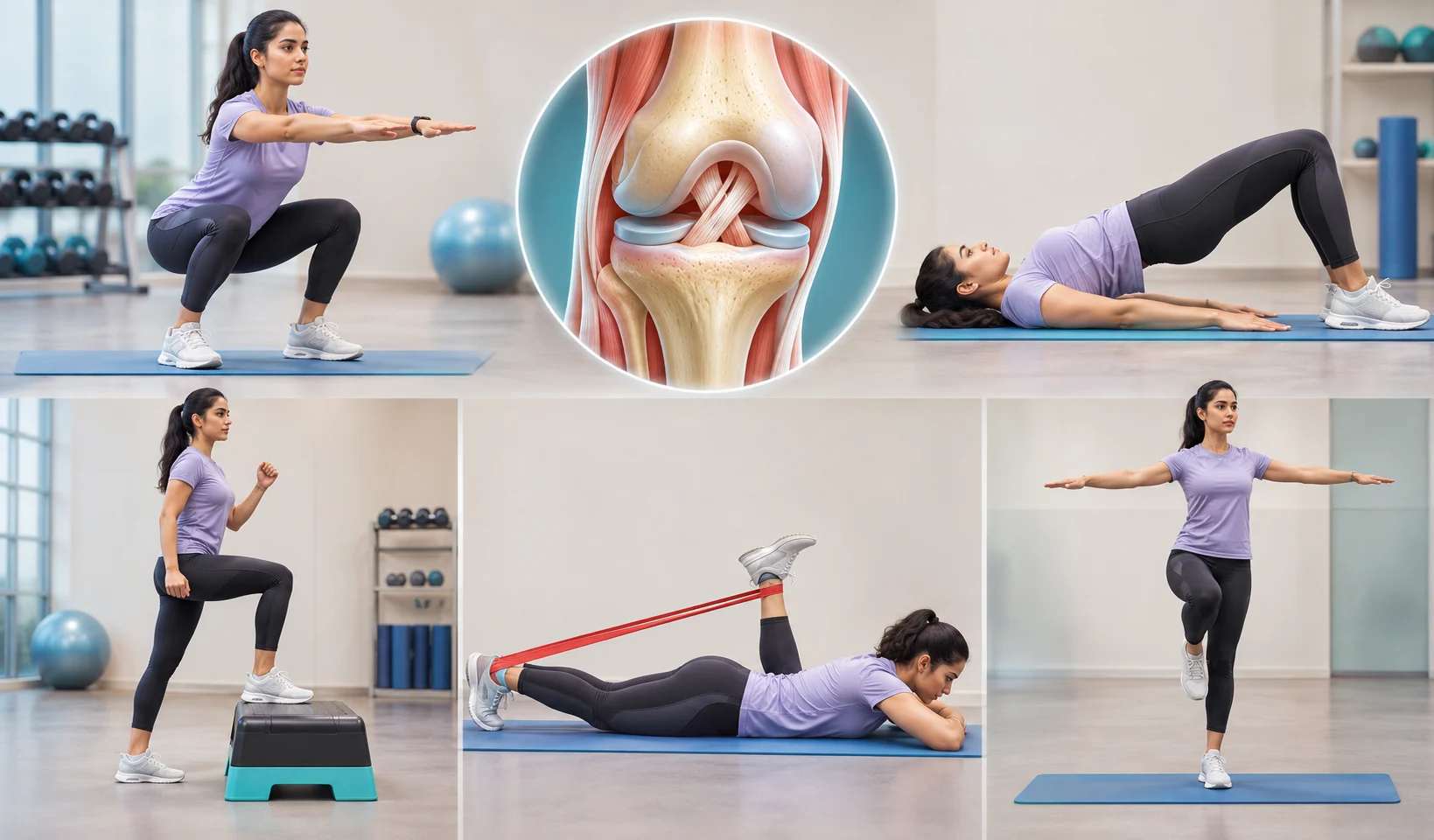
Strong quadriceps, hamstrings, glutes, and calves support knee movement. Include these ACL injury prevention exercises in your regular training routine.
Squats
Stand with your feet shoulder-width apart. Bend your hips and knees as though sitting on a chair. Keep your knees aligned with your toes.
Perform 2 sets of 10–12 repetitions.
Glute Bridges
Lie on your back with your knees bent. Lift your hips while tightening your glutes. Hold briefly and lower slowly.
Perform 2 sets of 12 repetitions.
Step-Ups
Step onto a low, stable platform. Push through your leading foot and straighten your leg. Step down with control.
Perform 10 repetitions per leg.
Hamstring Curls
Use a resistance band or suitable exercise equipment. Bend your knee slowly against resistance and return to the starting position.
Perform 2 sets of 10 repetitions.
Single-Leg Balance
Stand on one leg with your supporting knee slightly bent. Keep your hips level and maintain balance.
Hold for 20–30 seconds on each leg.
Focus on controlled movements rather than completing repetitions quickly.
Practise Safe Jumping, Landing, and Direction Changes
Landing technique plays an important role in reducing knee stress. Poor alignment during jumping and pivoting can increase ligament loading.
Include these movements in your ACL injury prevention exercises programme.
Jump-and-Hold
Jump vertically and land on both feet. Bend your hips and knees to absorb the impact.
Keep your knees aligned with your feet and hold the landing for two seconds.
Perform 2 sets of 8 repetitions.
Side-to-Side Hops
Hop sideways across a marked line. Start with both feet and land softly.
Maintain balance before progressing to single-leg hops.
Controlled Cutting Drills
Run forward at a moderate speed and practise slowing down before changing direction.
Bend your hips and knees, control your trunk position, and avoid uncontrolled twisting on a planted foot. A physiotherapist or qualified sports coach can help correct your technique and guide progression.
A Practical 20-Minute ACL Prevention Warm-Up
A structured warm-up combines muscle activation, balance, jumping, and sport-specific movement.
Try this sample routine before training.
| Exercise | Duration |
|---|---|
| Light jogging and dynamic mobility | 3 minutes |
| Squats and glute bridges | 4 minutes |
| Single-leg balance and controlled reaches | 4 minutes |
| Jump-and-hold landing drills | 3 minutes |
| Acceleration, stopping, and controlled turns | 6 minutes |
This is an illustrative routine for athletes without a current knee injury, not a replacement for a validated prevention programme.
Established programmes such as FIFA 11+ combine several exercise types. Research supports performing structured neuromuscular training at least two to three times weekly. A 2025 meta-analysis involving female team-sport athletes found approximately 50% lower ACL injury risk among participants following neuromuscular training programmes compared with controls. Results vary across sports and populations.
Regular participation and correct technique are essential.
Sport-Specific ACL Injury Prevention Tips
Different sports place different demands on your knees. Your prevention training should reflect the movements you perform most often.
- Football: Practise controlled stopping, cutting, and direction changes before increasing speed.
- Badminton: Strengthen single-leg balance and practise stable landings after jumps and lunges.
- Basketball: Focus on landing control after rebounds and maintaining balance during pivots.
- Cricket: Include lower-body strengthening and controlled stopping drills, particularly for fielding movements.
- Kabaddi: Practise balance, lateral movement, and controlled changes in direction during defensive drills.
These ACL tear prevention exercises should complement your regular strength and conditioning programme.
When Should an Athlete Seek Medical Evaluation?
Prevention training cannot eliminate every ACL injury.
Seek medical evaluation if you experience:
- A popping sensation during a knee injury.
- Rapid swelling after twisting your knee.
- Repeated knee instability or giving way.
- Difficulty bearing weight after an injury.
- Persistent pain or restricted knee movement.
An ACL injury specialist in Mumbai can assess knee stability and determine whether further investigations are necessary.
Not every ligament injury requires surgery. Treatment depends on the tear, knee stability, associated injuries, and sporting requirements. For athletes with significant instability, ACL Tear & Reconstruction Surgery may be considered after clinical assessment. Learn more about ACL Surgery in Mumbai and treatment options available through Dr. Aditya Pawaskar's ACL reconstruction service.
Athletes recovering from ligament injuries can also read ACL Tear Recovery Timeline: When Can You Return to Sports and Daily Activities? to understand rehabilitation milestones and return-to-sport considerations.
Consult Dr. Aditya Pawaskar for Sports-Related ACL Injuries
If knee instability or a previous sports injury affects your performance, consult Dr. Aditya Pawaskar, Consultant Arthroscopic Surgeon and Sports Injury Specialist in Mumbai. His clinical focus includes ACL injuries, knee arthroscopy, and sports-related ligament conditions. Athletes searching for an ACL tear surgeon in Mumbai can discuss their symptoms, knee stability, and treatment options during consultation. For Knee ACL tear treatment Mumbai, assessment helps determine whether structured rehabilitation or surgical management is appropriate. Consultations are available in Matunga East and Tardeo, Mumbai.
Frequently Asked Questions
Conclusion
Regular ACL injury prevention exercises can help athletes improve knee strength, balance, and movement control. Combining strengthening exercises with safe landing techniques, structured warm-ups, and sport-specific training can reduce injury risk. If you experience knee pain, swelling, or instability, seek professional assessment before returning to demanding activities. Consistent training and appropriate medical guidance can help you protect your knees and continue enjoying your sport.

Dr. Aditya Pawaskar, MS (Orthopaedics)
Specialist in Arthroscopy & Sports Injury, Mumbai