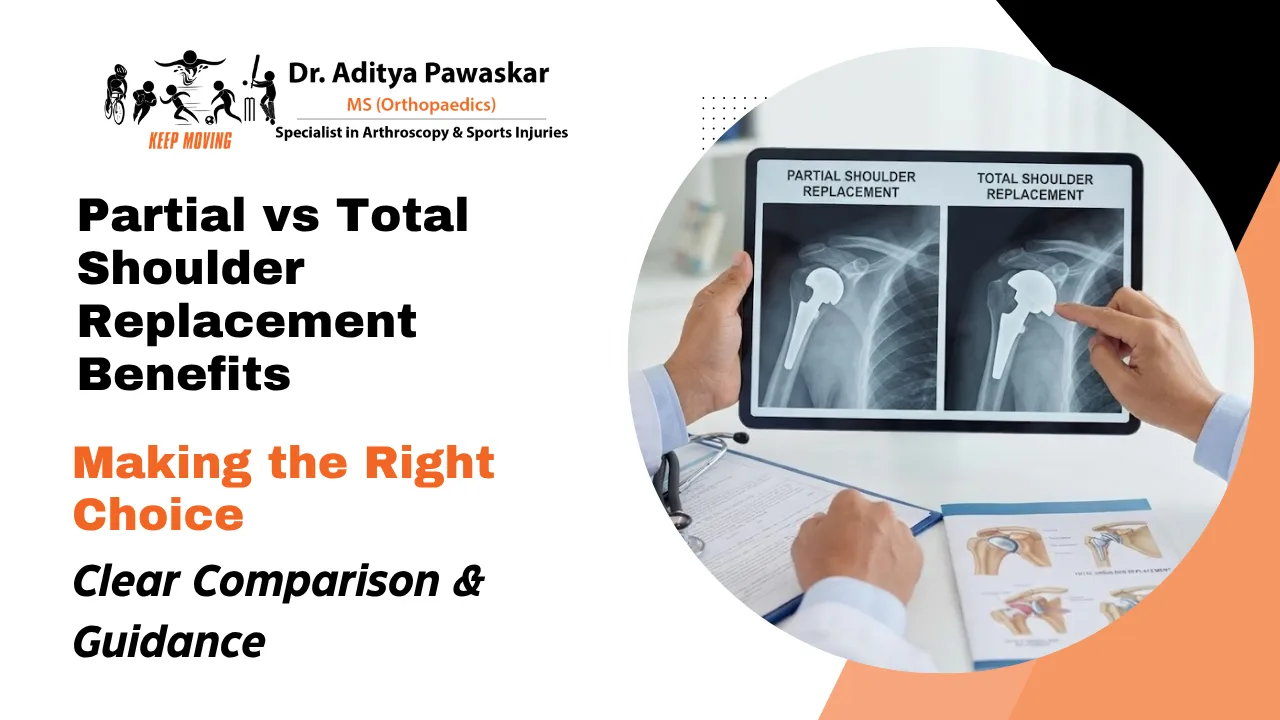
Partial vs Total Shoulder Replacement Benefits: Which Option Is Better?
Shoulder pain caused by arthritis, fractures, or severe joint damage can significantly affect everyday activities such as dressing, lifting objects, and reaching overhead.
When non-surgical treatments no longer provide relief, shoulder replacement surgery may be recommended to restore movement and reduce pain.
However, many patients have questions about the type of surgery:
“What is the difference between partial and total shoulder replacement?”
“Which shoulder replacement provides better benefits?”
The answer depends on the condition of your shoulder joint, the health of your rotator cuff, age, activity level, and long-term goals.
Both partial shoulder replacement (hemiarthroplasty) and total shoulder replacement are effective procedures, but they are performed for different conditions.
Dr. Aditya Pawaskar specialises in advanced shoulder treatments, including shoulder arthroplasty procedures, and provides personalised treatment plans based on each patient's shoulder condition.
What Is Shoulder Replacement Surgery?
Shoulder replacement, also known as shoulder arthroplasty, is a procedure where damaged parts of the shoulder joint are replaced with artificial implants.
The shoulder joint has two main parts:
- Humeral head: The ball-shaped upper part of the arm bone
- Glenoid: The socket portion of the shoulder blade
Depending on the damage, surgeons may replace one or both parts of the joint.
The main types include:
1. Partial shoulder replacement (hemiarthroplasty)
2. Total shoulder replacement
3. Reverse shoulder replacement
What Is Partial Shoulder Replacement (Hemiarthroplasty)?
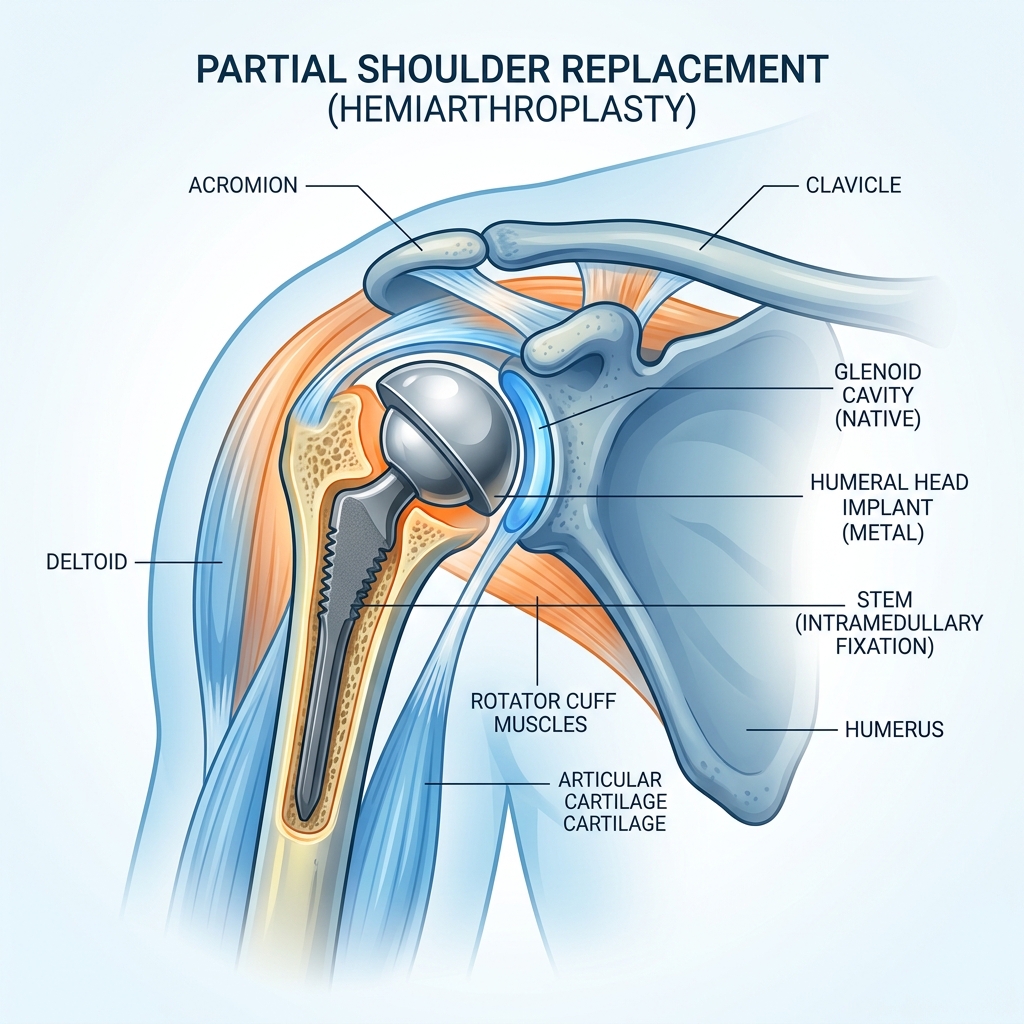
Partial shoulder replacement involves replacing only the damaged ball portion of the shoulder joint.
The surgeon replaces the:
✔ Humeral head
while keeping the natural shoulder socket intact.
This procedure is considered when the socket cartilage is healthy and does not require replacement.
Benefits of Partial Shoulder Replacement
1. Preservation of Natural Shoulder Anatomy
Since only the damaged portion is replaced, more of the patient's natural shoulder structure is preserved.
2. Suitable for Certain Shoulder Fractures
Partial replacement can provide effective treatment for complex fractures where repairing the bone may not be possible.
3. Reduced Surgical Complexity
Compared with replacing both sides of the joint, hemiarthroplasty involves a smaller surgical reconstruction.
4. Pain Relief and Improved Movement
Patients may experience:
- Reduced shoulder pain
- Improved arm function
- Better quality of life
5. Faster Recovery in Selected Patients
Some patients may experience a relatively simpler rehabilitation process depending on their condition.
What Is Total Shoulder Replacement?
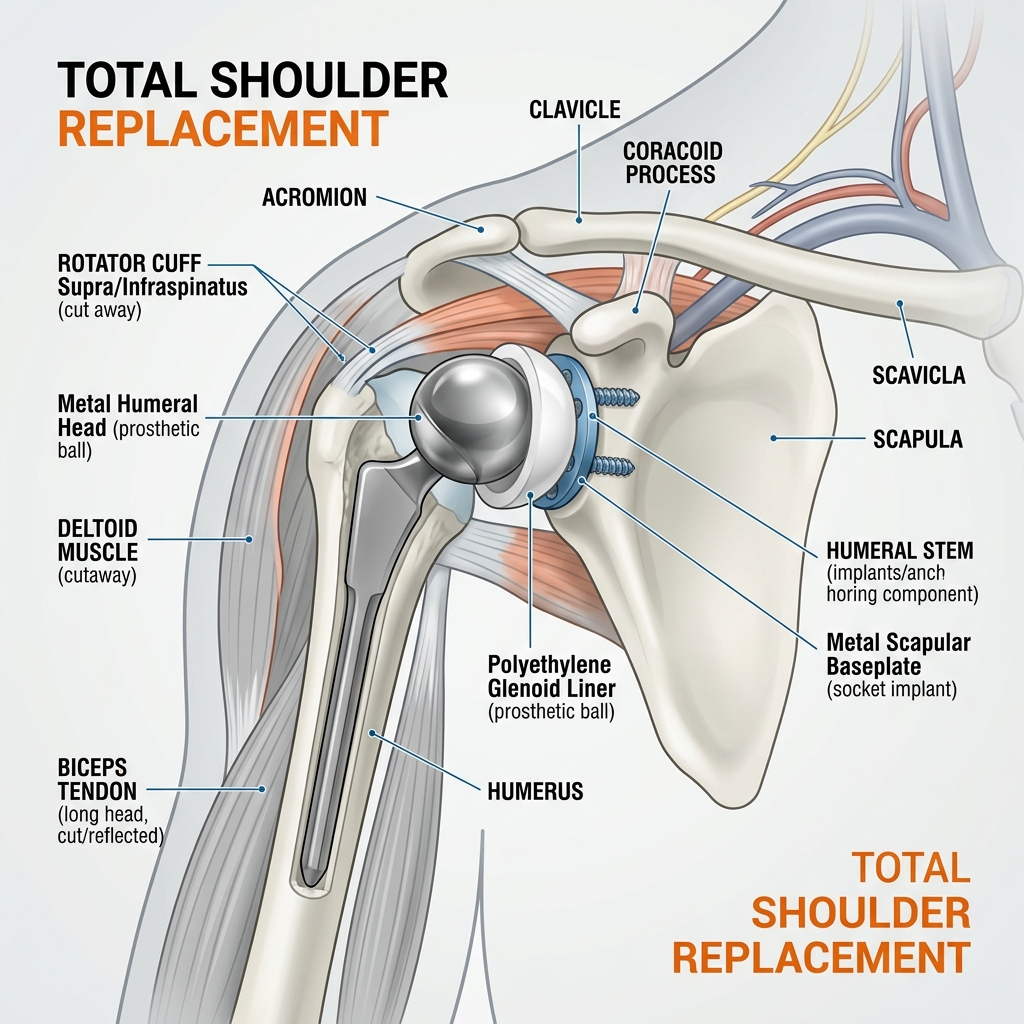
Total shoulder replacement involves replacing both major components of the shoulder joint:
- The damaged humeral head
- The damaged glenoid socket
A metal ball component replaces the upper arm bone surface, while a specialised component replaces the socket.
This procedure is designed to restore smoother joint movement when both sides of the joint are damaged.
Benefits of Total Shoulder Replacement
1. Better Pain Relief in Shoulder Arthritis
Total shoulder replacement can significantly reduce pain caused by advanced arthritis.
It helps restore smoother movement by replacing damaged joint surfaces.
2. Improved Shoulder Function
Patients may experience improvement in:
- Arm movement
- Daily activities
- Shoulder comfort
3. Restores Joint Mechanics
Replacing both damaged surfaces helps recreate a more natural shoulder joint movement pattern.
4. Better Option When Socket Damage Exists
If the glenoid cartilage is significantly worn, replacing only the ball may not provide optimal results.
Total shoulder replacement addresses damage on both sides of the joint.
Partial vs Total Shoulder Replacement: Key Differences
| Feature | Partial Shoulder Replacement | Total Shoulder Replacement |
|---|---|---|
| Other Name | Hemiarthroplasty | Total Shoulder Arthroplasty |
| Components Replaced | Ball portion only | Ball and socket |
| Best For | Selected fractures, limited joint damage | Advanced arthritis with joint surface damage |
| Rotator Cuff Requirement | Usually needs functional rotator cuff | Requires healthy rotator cuff function |
| Joint Reconstruction | Partial | Complete |
| Goal | Replace damaged humeral head | Restore entire shoulder joint |
Which Is Better: Partial or Total Shoulder Replacement?
There is no single “best” shoulder replacement option for every patient.
The right procedure depends on:
Condition of Shoulder Joint
If only the humeral head is damaged and the socket is healthy, partial replacement may be suitable.
If both surfaces are damaged, total shoulder replacement may provide better results.
Rotator Cuff Health
The rotator cuff plays an important role in shoulder stability and movement.
Patients with a functioning rotator cuff may benefit from traditional total shoulder replacement.
Patients with severe rotator cuff damage may require a different approach, such as reverse shoulder replacement.
Age and Activity Level
Treatment decisions may vary depending on:
- Patient age
- Lifestyle requirements
- Activity expectations
- Bone quality
Recovery After Partial vs Total Shoulder Replacement
Recovery varies depending on the procedure and individual healing.

Early Recovery
Patients usually focus on:
- Pain control
- Protecting the repaired shoulder
- Gentle guided movements

Rehabilitation Phase
Physiotherapy helps improve:
- Range of motion
- Muscle strength
- Shoulder coordination
Long-Term Recovery
Most patients gradually return to daily activities with continued improvement over several months.
Activities After Shoulder Replacement
After successful recovery, many patients can return to:
- ✔ Walking
- ✔ Household activities
- ✔ Light exercise
- ✔ Daily self-care activities
However, activities involving heavy lifting or repetitive overhead stress may require restrictions.
Factors That Influence Shoulder Replacement Success
Successful outcomes depend on:
Accurate Diagnosis
Identifying the exact cause of shoulder pain helps select the right procedure.
Surgical Expertise
Proper implant positioning and surgical technique are important for long-term results.
Implant Selection
The implant should match:
- Patient anatomy
- Bone quality
- Shoulder condition
Rehabilitation
Following physiotherapy instructions improves recovery.
Why Choose Dr. Aditya Pawaskar for Shoulder Replacement Surgery in Mumbai?
Dr. Aditya Pawaskar is a Consultant Arthroscopic Surgeon and Sports Injury Specialist in Mumbai specialising in shoulder and knee conditions.

His expertise includes:
- ✔ Partial shoulder replacement
- ✔ Total shoulder replacement
- ✔ Reverse shoulder replacement
- ✔ Rotator cuff tear treatment
- ✔ Shoulder arthroscopy
- ✔ Sports injury management
He provides personalised treatment plans based on:
- Shoulder examination
- MRI and X-ray findings
- Joint condition
- Patient lifestyle goals
Consultation With Dr. Aditya Pawaskar
Patients experiencing:
- Persistent shoulder pain
- Difficulty lifting the arm
- Shoulder arthritis symptoms
- Limited shoulder movement
- Previous failed shoulder treatment
can consult:

Dr. Aditya Pawaskar
Consultant Arthroscopic Surgeon & Sports Injury Specialist
Specialised Care For:
- Shoulder Replacement Surgery
- Rotator Cuff Injuries
- Shoulder Arthritis
- Sports Injuries
📍 Consultation Locations:
Matunga Clinic, Mumbai
Apollo Spectra Hospitals, Tardeo, Mumbai
A detailed evaluation helps determine whether partial, total, or reverse shoulder replacement is the right treatment option.
Frequently Asked Questions (FAQs)
- 1. What is the main difference between partial and total shoulder replacement?
Partial shoulder replacement replaces only the damaged ball portion, while total shoulder replacement replaces both the ball and socket of the shoulder joint. - 2. Which shoulder replacement is better for arthritis?
Total shoulder replacement is often preferred for advanced shoulder arthritis when both joint surfaces are damaged and the rotator cuff is functioning properly. - 3. Is partial shoulder replacement less painful than total shoulder replacement?
Both procedures aim to reduce pain. Recovery and discomfort depend on the patient's condition, surgery type, and rehabilitation. - 4. How long does shoulder replacement recovery take?
Most patients gradually improve over several months with proper physiotherapy and follow-up care. - 5. Can I return to normal activities after shoulder replacement?
Many patients return to daily activities after recovery, but heavy lifting and high-impact activities may need restrictions. - 6. Which shoulder replacement is suitable for rotator cuff tear?
Patients with severe irreparable rotator cuff tears may require reverse shoulder replacement rather than partial or traditional total shoulder replacement.
Conclusion
Both partial and total shoulder replacement procedures can provide significant benefits for patients with painful shoulder conditions.
Partial shoulder replacement may be suitable when only the humeral head is damaged and the socket remains healthy.
Total shoulder replacement may provide better results when both the ball and socket are affected due to arthritis or joint damage.
The ideal procedure depends on your shoulder condition, rotator cuff health, lifestyle needs, and long-term goals.
For personalised evaluation and expert guidance, consult Dr. Aditya Pawaskar, Consultant Arthroscopic Surgeon and Sports Injury Specialist in Mumbai.

Dr. Aditya Pawaskar, MS (Orthopaedics)
- Specialist in Arthroscopy & Sports Injury, Mumbai
Visit: https://dradityapawaskar.com/